Austrian German
What makes it so special, and how does it differ from German spoken in Germany
Austrian German is a standard version of the German language spoken in Austria. Alongside Federal High German and Swiss High German, it constitutes a distinct variety. It is used in administration, education, the media and public life in Austria, and is both legally and normatively established.
Typical differences can be seen in vocabulary, pronunciation, grammar and style, most of which date back to the Habsburg Monarchy and were shaped by the nation’s cultural and institutional quirks.
The Differences between Austrian Dialect and Standard Language
Alongside standard Austrian German, Austrian dialects are an integral part of the country’s linguistic landscape. These regional language forms often differ significantly from the standard language and are mainly used in everyday speech.
Most Austrian dialects belong to the Bavarian language group, while Alemannic dialects are spoken in Tyrol and Vorarlberg, Austria’s most Western regions. Naturally, these dialects have evolved over time and are heavily defined by the given locale, meaning that the actual spoken language can greatly differ not only between federal states, but also across different smaller regions within one single federal state.
In everyday life, many speakers regularly switch between dialect and standard language depending on the situation, a phenomenon known as ‘situation-dependent language use‘ or ‘code-switching‘.
How to speak like an Austrian
From vocabulary quirks to grammar surprises –there are a couple of things to look out for when trying to sound a little more like a local.
A central feature of Austrian German is its distinct vocabulary. Many terms – also known as Austriacisms – differ from those used in Germany, but this does not make them any less correct. We’ve rounded up some of the most interesting examples for you. If you
fancy putting your knowledge to the test, there’s a quiz waiting for you at the end of this article.
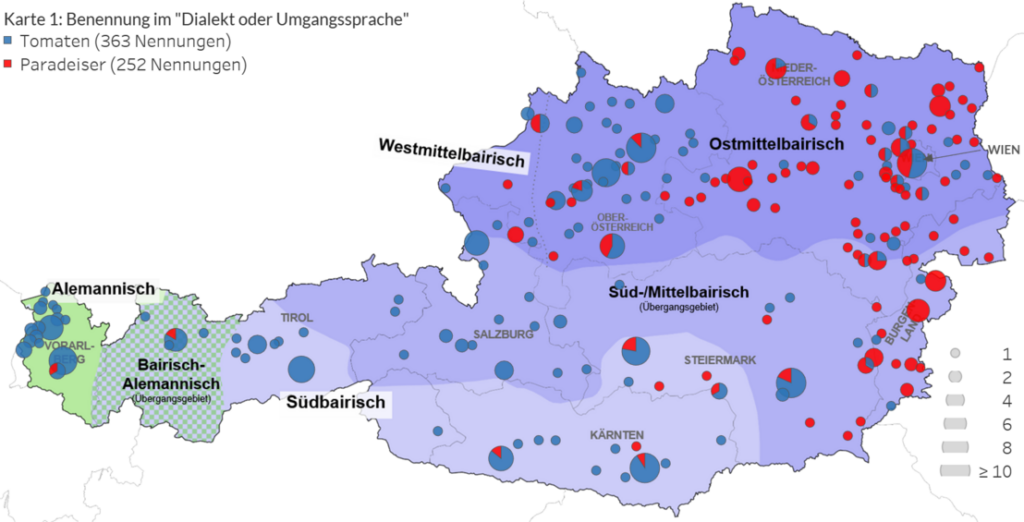
Please note that these terms are not used uniformly across Austria. Regional differences play a significant role. In the west and in regions bordering Germany in particular, Federal German terms are more common. The following chart illustrates one of these differences.
© Theresa Ziegler, SBF-Projekt Deutsch in Österreich (DiÖ)
Did you know? Austrian German also has its own administrative and legal terms. Some of this vocabulary is even protected at the European level and certain terms are explicitly recognised as Austrian designations in EU law – particularly in the food sector.
Grammar and Language Use:
Austrian German vs. Standard German
There are also subtle differences in grammar and everyday usage compared to Federal German High German. The perfect tense is often used instead of the simple past, reflecting a more colloquial style of speech.
Use of Articles
Besonders beim Artikelgebrauch fällt ein markanter Unterschied auf: Personennamen werden in Österreich deutlich häufiger mit bestimmtem Artikel verwendet als in Deutschland – etwa „der Hans“, „die Maria“ oder „die Huber Mitzi“ (Artikel + Nachname + Vorname). Während diese Formen in Deutschland oft dialektal wirken, sind sie in Österreich in vielen Kontexten, auch standardsprachlich, völlig üblich.
Plurals & Diminutives
There are also distinct plural forms. While ‘Kinderwagen’ (stroller) has a zero plural in German (‘die Kinderwagen’), the form ‘die Kinderwägen’ is common in Austria.
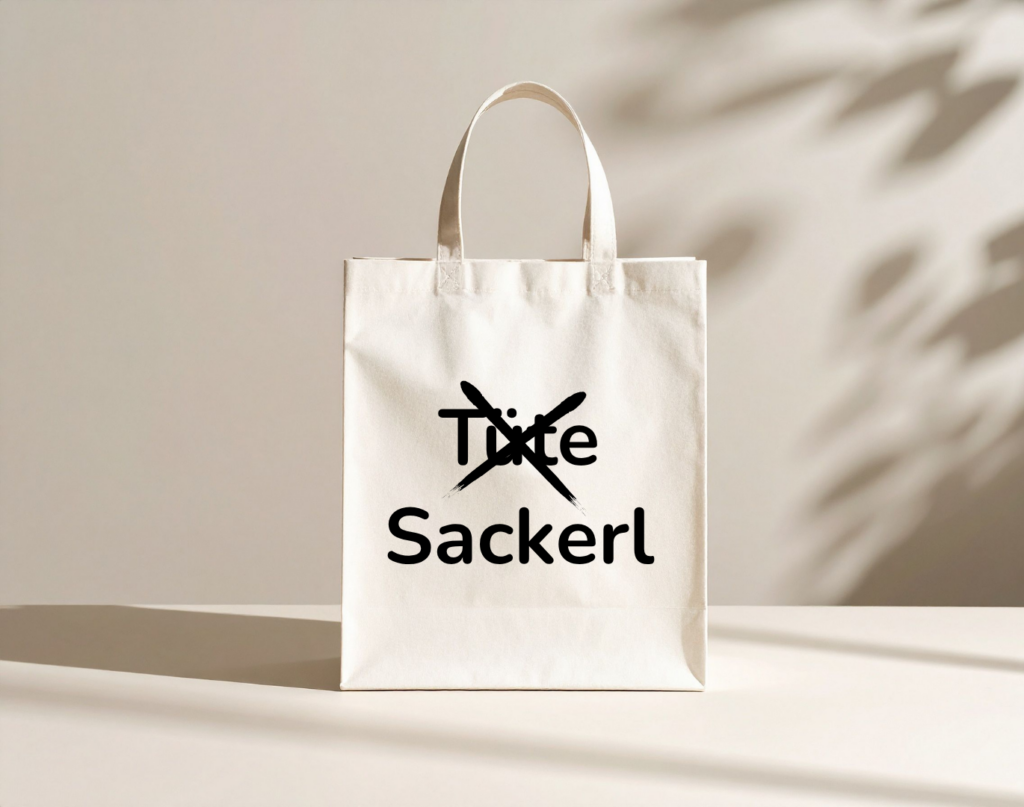
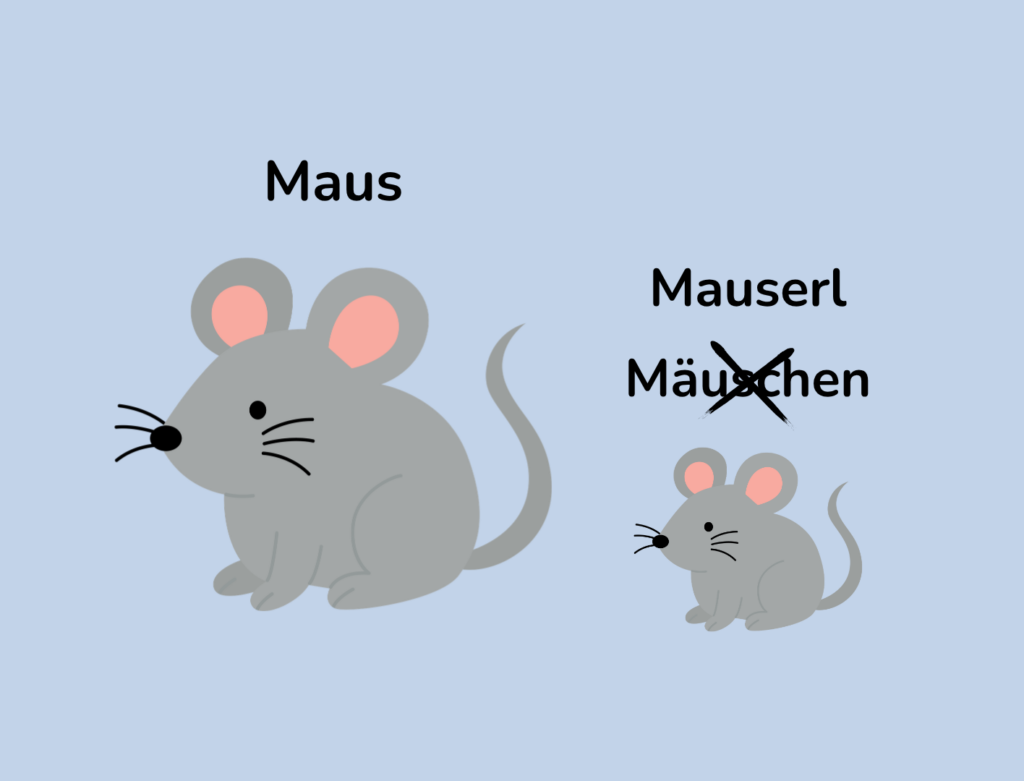
But that’s not all. Diminutives are also frequently used, especially in colloquial speech. Germany predominantly uses the ending ‘-chen’ (e.g. ‘Gürkchen’ meaning ‘small cucumber’, ‘Säckchen’ meaning ‘small bag’, and ‘Mäuschen’ meaning ‘small mouse’), whereas Austria favours ‘-erl’ or ‘-l’ (e.g. ‘Gurkerl’, ‘Sackerl’, and ‘Mauserl’). Interestingly, ‘Sackerl’ has become a standard word, regardless of the actual size.
Pronunciation in Austria
The pronunciation of Austrian High German also differs quite significantly from German pronunciation.

Word Stress
For instance, the stress in words such as ‘Kaffee’ (coffee) and ‘Telefon’ (telephone) is on the last syllable in Austria (ka-FEE, tele-FON), whereas in Germany it falls on the first syllable (ka-FEE, tele-FON).

Audio sample: Ka-FEE (‘coffee’, Austria)

Audio sample: KA-ffee (‘coffee’, Germany)
Plosives & R-sounds
Plosives such as p, t and k are generally softer; in eastern Austria, ‘Tee’ (tea) sounds more like ‘Dee’, and ‘Kakao’ (hot chocolate) more like ‘Gagau’. The ‘r’ is rolled in western regions such as Tyrol and Vorarlberg, but it is softer or almost absent in eastern regions, which gives Austrian pronunciation a melodic, softer quality.
Phonetic Features
Characteristic sounds include a less sharp voiceless ‘s’ (in ‘Salz’ (salt) or ‘Nase’ (nose)), a more open pronunciation of ‘-e’ at the end of words or in unstressed syllables (in ‘Straße’ (street) or ‘gesagt’ (said)), and a more open ‘ä’ (in ‘Mädchen’ (girl) or ‘Käse’ (cheese)).
Audio sample: Käse (‘cheese’, Austria)
Audio sample: Käse (‘cheese’, Germany)
How Austrian German shapes our Identity and the way we talk
The Austrian standard variety combines linguistic norms with cultural identity, enabling seamless communication across the entire German-speaking world, while at the same time preserving national peculiarities.
Especially seen in an international context, it significantly enriches the diversity of the German language, showing that standard languages can have multiple equally valid varieties.
Find out how many Austriacisms you already know and put your knowledge to the test:
You might also be interested in
German courses at the Österreich Institut
Whether it’s a beginner’s course, a group course or German for companies, we have the right course for you. With experience and sensitivity, our course leaders will help you achieve your learning goals.
Find your language level
What do the levels A1 to C2 mean? We are happy to help you find the right language level for you. We can also offer you the right course for your individual German language skills, both online and on-site at our locations.