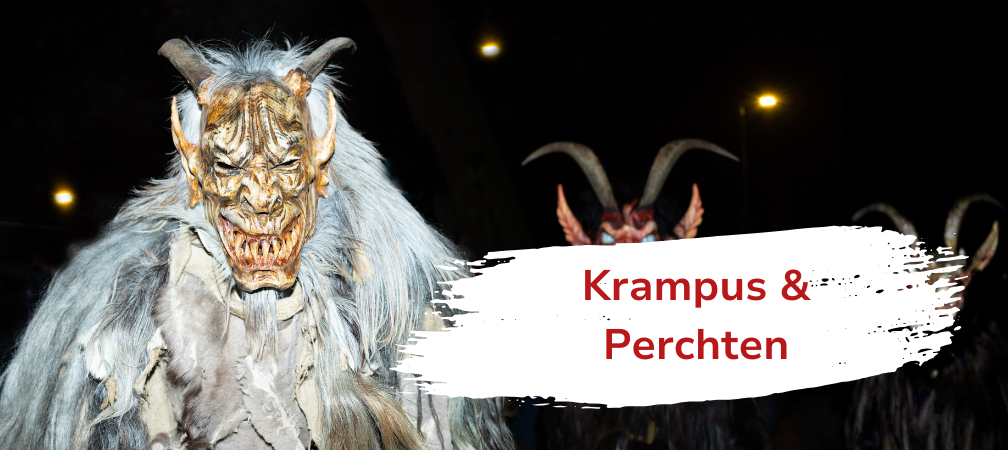
On cold and dark winter nights, the sound of heavy drums and shrill bells cascades through the narrow streets. Fearsome, shaggy creatures emerge from the mist, horns glinting in the fire, the air filled with the sound of clattering chains while children are pressed tightly against their parents. It’s that time of the year when Krampus and the Perchten roam the streets of towns and villages across the country – a long-standing Austrian custom that can be as terrifying as it is fascinating. But where do these ancient creatures come from, why do they appear year after year, and what exactly is the difference between a Krampus and Perchten? Let’s take a closer look.
What Are Perchten? – History & Regional Origins
Perchten are creatures rooted in pre-Christian times, blending pagan nature beliefs and old seasonal rituals with Christian traditions. As early as around AD 500, noisy masked processions were part of Roman-Germanic celebrations marking the turn of the year. The custom is particularly deeply embedded in Austria’s eastern Alpine regions, though since the turn of the millennium it has spread to other areas as well.
Perchten runs traditionally take place during the twelve “Raunächte” – the twelve darkest nights of winter, beginning with the winter solstice and concluding with Epiphany. These processions symbolise the driving out of winter and evil spirits while at the same time heralding the coming of spring and the return of light.
| Did you know? The term “Raunächte” does not actually come from the harsh weather conditions of December, but is derived from the German word “Rauch”, which means “smoke”. During this significant period, it is a traditional custom within Alpine regions to bless homes and farmsteads with incense to keep evil spirits and demons away. |
What’s the difference between Krampus and Perchten?
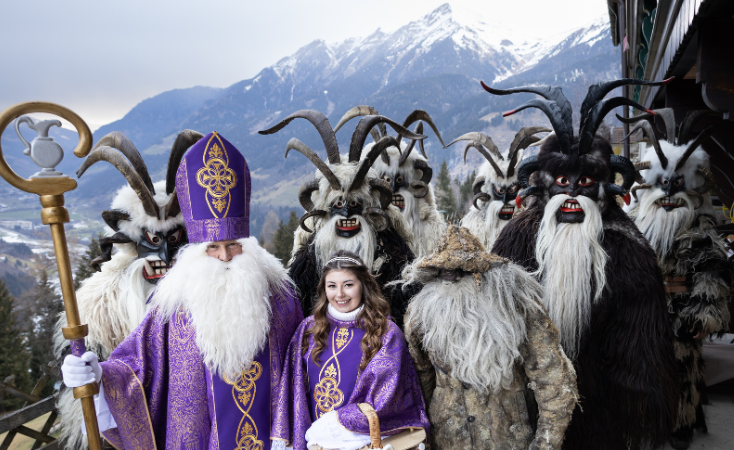
The Krampus appears as the companion of St Nicholas on 5 December. Nicholas serves as a protective figure who brings gifts to well-behaved children, while Krampus – a deviation from Perchten – is responsible for punishing those who have misbehaved. The name Krampus derives from the Middle High German “Krampen” meaning “claw”, or from the Bavarian “Krampn”, which refers to something lifeless, dried out or withered. In many regions, this sinister companion is also known as Knecht Ruprecht.
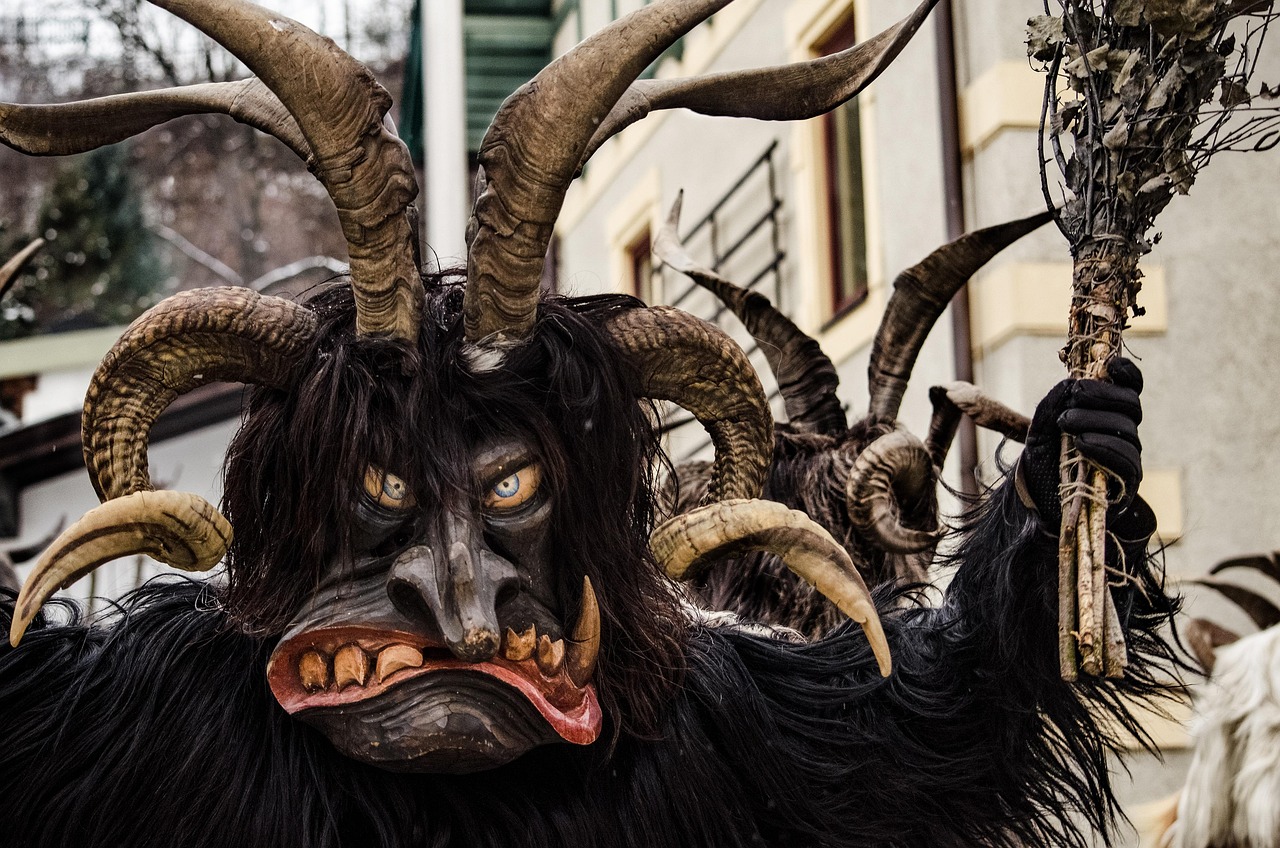
Krampus and Perchten are often confused, as they look very similar. Both typically wear sheep or goat hides and are equipped with bells and bundles of birches. However, there are a few differences: a Krampus mask is usually smaller, weighing between two and four kilograms, and is distinguished by a long, protruding red tongue and a single pair of horns.
In contrast, Perchten masks are significantly larger and heavier, weighing around 15 to 20 kilograms. They often have rough, sometimes animal-like facial features and may feature anything from one to several pairs of horns – or none at all.
Perchten Then and Now: How a Forbidden Custom turned into a Celebrated Cultural Event
In the 15th century, many pagan customs were increasingly eyed with suspicion. With Christianity spreading, rituals such as the Perchten run and the general depiction of “demonic” figures were more and more frowned upon as unwanted remnants of a pre-Christian past. To consolidate the Church’s influence, these rites and festivities were subsequently banned by ecclesiastical authorities in many Alpine regions – sometimes they were forbidden entirely, sometimes they were only allowed to go ahead under strictly regulated conditions. Despite these efforts, the tradition never fully disappeared. With the separation of church and state and the growing interest in folk culture during the 19th century, it experienced a true revival. Towards the end of the 20th century, it gained renewed significance as more and more communities began consciously preserving and celebrating their regional roots and long-standing customs.
Today, Perchten runs are hugely popular winter events which draw in crowds from all over the world. Many municipalities also use these events as a means to boost the local economy, with hotels, restaurants and local workshops all benefitting greatly from the influx of curious visitors.
How does a Perchten run work?
Today, Krampus and Perchten runs appear as impressive spectacles that blend tradition with modern event culture. Most events start in the early evening, usually between 5 p.m. and 8 p.m. – the time when darkness and firelight make the eerie creatures appear particularly striking. In many towns, groups parade through the streets in organised processions, accompanied by heavy drumbeats, loud bell-ringing and the clattering of chains. Music, dancing and playfully frightening the audience are all part of the experience. Ritual elements such as circle dances, the swinging of birch rods and symbolic gestures intended to banish the old and welcome the new also feature prominently.
In addition to the “main characters”, a wide variety of accompanying characters appear in the processions, varying from region to region. Some characters also take on a specific role or function across the various stages of the event: Witches lead the procession, symbolically sweeping away the snow with their brooms to make space for the arrival of spring. A goat-like demon is usually included to serve as a fertility symbol and calm children down rather than scare them.
The so-called “Moosmandl” (literally translating to “little moss man”) is regarded as a forest spirit of fertility who brings light into the dark woods and keeps pests at bay. The figure of Death, meanwhile, serves as a reminder of mortality and the circle of life. In addition, there are countless local characters, each rooted in regional myths and legends – a clear indicator of how deeply this tradition is embedded within local communities.
By the way: The manner in which these customs are celebrated also significantly varies between urban and rural areas: In big cities and towns, Perchten runs usually take the form of an orderly procession along a designated route within a cordoned-off area, including stage performances and typically involving a fixed schedule. In villages, however, small groups often move from house to house to check that all is well, offering wishes for peace, good fortune and health – traditionally in exchange for food and drink.
Things to Keep in Mind: Tips for Your Visit
To ensure that attending a Perchten or Krampus run is an enjoyable experience for everyone, it’s worth following a few simple guidelines and safety precautions:
- Be respectful: The intricately carved masks and elaborately crafted costumes are often handmade and delicate – never pull on horns or fur.
- Keep children close: The loud bells, fire and fearsome figures can unsettle even the bravest children – and may even cause them to run and hide. As such, parents should keep a close eye on their little ones at all times. Especially for younger children, a cordoned-off or elevated viewing area is the perfect place to follow the event from a safe distance. Speaking of which:
- Maintain your distance: The heavy masks worn by the characters severely limit their field of vision – meaning smaller spectators can easily be overlooked.
- Beware of the birch: Especially in western Austria, blows from birch rods are part of the tradition, while in the east they tend to be only symbolic. Nonetheless, there’s always a chance you might be on the end of a light slap – sometimes deliberately, sometimes simply because the Percht can’t see properly.
From Christmas traditions to music, art and culture, customs and traditions are deeply rooted in the Austrian soul. Just head to our blog to discover more about what defines the Alpine republic and its people – for example what regional dialects there are, the history and meaning of traditional dress, what traditional Austrian cuisine is all about, and which traditional coffee specialities you absolutely need to try. And to help you navigate everyday life, we’ve also put together some of the best tips for learning German. Happy reading!