
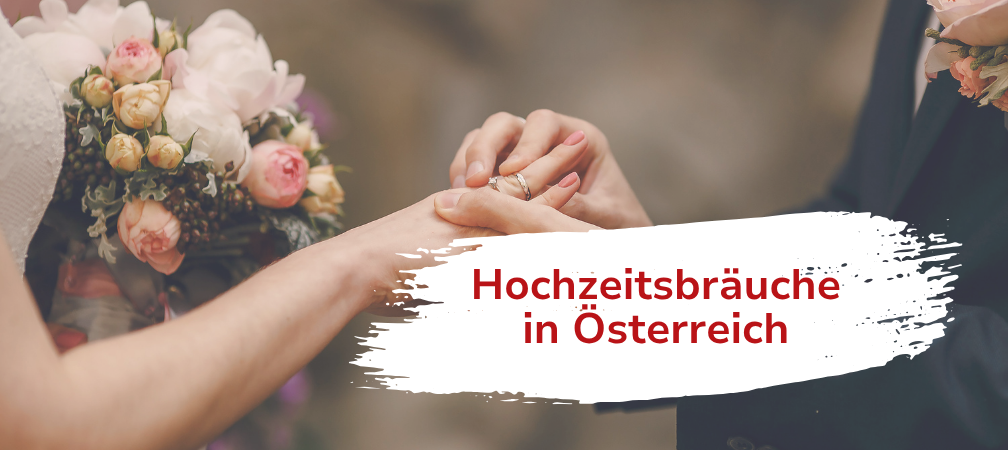
Whether a church wedding surrounded by family, a private one-on-one ceremony at the registry office or a lavish wedding extravaganza abroad: how a couple chooses to get married is solely up to them. While the “classic” wedding may have fallen somewhat out of fashion over the past decades, there are still many old Austrian traditions that remain an integral part of the celebrations to this day. Let’s take a look at the most popular ones.
Before the wedding: The Polterabend
Just like in many other countries, it’s common in Austria for the bride and groom to celebrate their final days of singledom in style – separately, of course. What is known as a bachelor or bachelorette party (or stag and hen do) in English is called a “Polterabend” in Austria. Back in the day, the Polterabend was usually held the day before the wedding, nowadays it often takes place several weeks, if not even months, in advance.
The event is normally organised by the best man or maid of honour, with the celebrations following one simple rule: anything goes, as long as it’s fun. A typical Polterabend – often shortened to “Polterer” – is therefore no longer just a boozy get-together before walking down the aisle but can involve anything from sporting activities to a weekend trip or even a short holiday abroad. Moreover, it has become customary to “torment” the bride or groom with various tasks and challenges throughout the celebrations. This can include anything from wearing a costume to selling miniature bottles of schnapps, sweets and other knick knacks, or completing a to-do list over the course of the day (or evening).
What is the difference between a Polterabend and a bachelor party?
Although the terms Polterabend and “Junggesellenabschied” – the German word for bachelor party – are often used interchangeably in Austrian dialect, historically speaking they are two altogether different customs. The Polterabend traditionally refers to friends and family coming together the day before the wedding to celebrate, which also involves smashing plates and all kinds of dishes (no mirrors or glass!) with a loud clatter: a ritual meant to scare away demons and bring the couple good fortune.
Smashing crockery is still a fairly common custom in Burgenland and Carinthia, where bowls and plates are sent flying after the wedding. According to tradition, the bigger the number of broken pieces, the more children the bride and groom will be blessed with in the future.
“Poltern”, on the other hand, describes exactly what the bachelor party used to be traditionally (and mostly still is to this day): back then, the groom was required to treat his friends to wine in order to buy his way out of the group – symbolically easing the collective grief over his departure with copious amounts of drink. Beyond that, general silliness and joking around used to be the order of the day, including music and dancing.

The big day: From wedding salutes to stealing the bride
There’s plenty going on on the big day: besides internationally recognised traditions such as the bouquet toss, cutting the wedding cake or the first dance as a married couple, every corner of the country has customs that are, simply put, typically Austrian. Especially in rural areas, the classic white wedding dress and evening attire are frequently ditched in favour of traditional Austrian clothing as well.
Waking the bride / Wedding gun salutes
The big day traditionally starts early with a ritual called waking the bride (“Brautwecken”) or wedding gun salutes (“Hochzeitsschießen”) – mostly the early start is just for the bride, assuming the couple have kept to the tradition of spending the night before the wedding apart. Particularly in Carinthia and Styria, it’s customary to rouse the bride and groom from their sleep at 4 or 5 AM with firecrackers, gun salutes or (brass) band music. This is followed by a hearty breakfast featuring classic dishes of Austrian cuisine. Traditionally, wedding soup is served – a clear beef broth served with thin strips of pancake (“Frittaten”), or small fried batter pearls (“Backerbsen”). In Carinthia, things get a touch heartier with goulash soup. Either way, the aim is the same: to ensure no one goes hungry until the next big feast.
The false bride
Another popular custom is the so-called “false bride”. When the groom comes to collect his beloved from her parents’ house in the morning, attempts are made to palm off someone else on him. Typically, this would be the bride’s friends or female members of the family who take on the role, trying to convince the groom of their own merits. Naturally, without success.
Wedding buttonholes
Along with floral decorations, wedding guests are often given small buttonholes (“Brautbüscherl”) before the celebrations begin, which are customarily pinned to the left chest. This can be anything from a single flower to a small bouquet or even just a simple sprig of rosemary.
The guard of honour
When the couple leave the venue after the wedding ceremony, the guests line up to the left and right of the exit to form a guard of honour. As in many other parts of the world, the newlyweds are often showered with rice and flower petals to wish them a happy future. Traditionally, however, a key part of the guard of honour was to block the couple’s way – a symbolic representation of conquering obstacles together. At the same time, the two rows are also meant to show that friends and family will always stand by the couple’s side.
A sort of reverse version of this custom is the ritual of the “road block”. Here, friends and family block the bride and groom’s route to the church or registry office with a decorated rope. In order to get around it, the couple usually need to complete small tasks designed to test their skills and commitment to each other. According to tradition, the couple may get married only if they’re successful.

Sawing a log
The first challenge the newlyweds have to overcome is cutting a log. Using a pull saw, the bride and groom have to cut through a tree trunk while the guests cheer them on. True to the motto: teamwork makes the dream work. Which is why you’ll still find many variations of the classic log challenge to put the couple to the test.
The wedding procession
Every Austrian knows that loud, persistent honking on the roads can only mean one thing: wedding time! Traditionally, a convoy sets off from the church or registry office to the reception, led by the bride and groom’s car which is usually decorated with flowers. The rest of the guests follow behind, usually with colourful ribbons fluttering from wing mirrors and horns blaring.
Bride stealing
If the groom doesn’t keep a close eye on his bride, she might well disappear: during bride stealing (“Brautstehlen”), the groom’s friends and relatives secretly whisk the bride away, usually to a nearby pub. There, they drink and celebrate until the abandoned groom (normally together with the female wedding guests) seeks her out and claims her. Ideally, he’ll do so before midnight, otherwise he forfeits his right to the wedding night. The ransom is normally paid by settling the bar bill – unless the kidnappers have forgotten to bring along the bridal bouquet, in which case the groom can simply swap it for his bride.
Wreath dance
The wreath dance (“Kranzerltanz”) is not only the ideal opportunity to get young and old onto the dance floor, but also a great way for the couple to top up the wedding funds. The bride and groom offer themselves as dance partners for the guests in exchange for a small fee. Plus, whoever pays the most gets to take the bridal wreath home at the end of the night.
Almonds as a gift
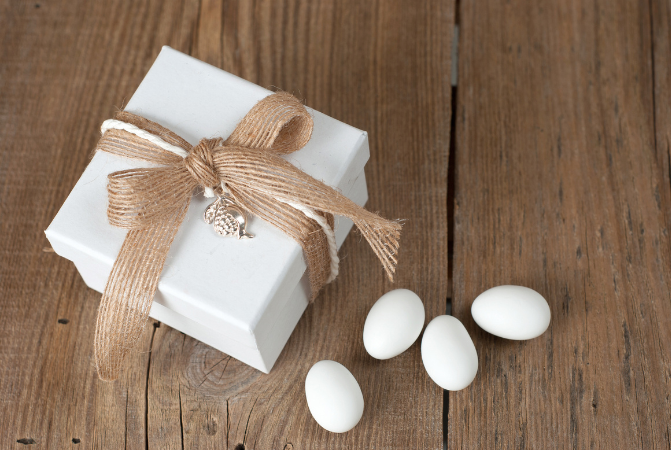
In Austria, sweet roasted almonds are traditionally presented to the wedding guests as a gift. Usually there are five of them, lovingly wrapped up in little tulle bags, each representing one thing you’d wish your loved ones: happiness, love, prosperity, health and fertility.
After the wedding: The morning gift
Some enjoy a quiet day at home, some fly off on their honeymoon, others are still clearing away the remains of yesterday’s party with their bleary-eyed best man and maid of honour: however differently the day after the wedding is spent, many couples still uphold the traditional “Morgengabe”, a small gift in the morning. First thing after waking, they exchange presents as a token of their mutual love and appreciation, usually a piece of jewellery. Nowadays, it’s quite common to break with this tradition and exchange the morning gift just before the wedding – allowing the bride and groom to show off their new piece on the big day.
Whether a huge event or a wedding ceremony with just a few close friends and family, the many traditions make Austrian weddings a truly unforgettable, one-of-a-kind experience – and show that many old customs still have their place in today’s modern world. Speaking of traditions: there’s even more to discover on our blog. Check out our guide to the Viennese ball season, learn more about Fasching and Krampus, or brush up your knowledge on Austria’s best-known Easter customs. Happy reading!