
Tradition and customs play an important part in Austria’s Southernmost region. Fiercely proud of its rich cultural heritage, you’ll find a plethora of events and festivities throughout the year to celebrate everything the locals love – from culture to cuisine and beyond. While many important traditions – like Perchten runs in December or the stealing of the maypole in spring – are observed in all parts of Austria, there are some customs that are quintessentially Carinthian. Here are the five to know:
Villacher Kirchtag (Villach Fair)
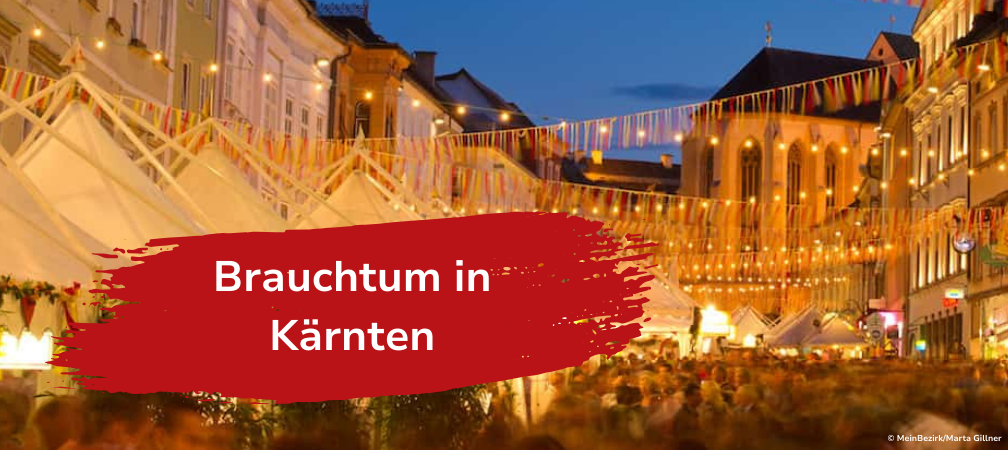
In early August, the city of Villach is all about one thing: the local fair. Think brass music, copious amounts of iconic “Kirchtagssuppe”, a rich and aromatic soup, served in local taverns, and quaint wooden huts dotted along the streets serving as the backdrop for animated celebrations. Around 500,000 people travel to Villach every year to party until the early morning hours, many of them dressed to the nines in traditional Austrian clothing – making it Austria’s biggest traditional festival. For the locals, it’s an event not to be missed, and hotly anticipated year after year.
| Tip: In addition to big fairs and local festivities, you’ll find plenty of festivals and cultural events happening in Carinthia and other parts of Austria throughout the summer. Check out our guide to Austrian music festivals for some inside tips on what events you should definitely include in your itinerary. |
Bleiburger Wiesenmarkt
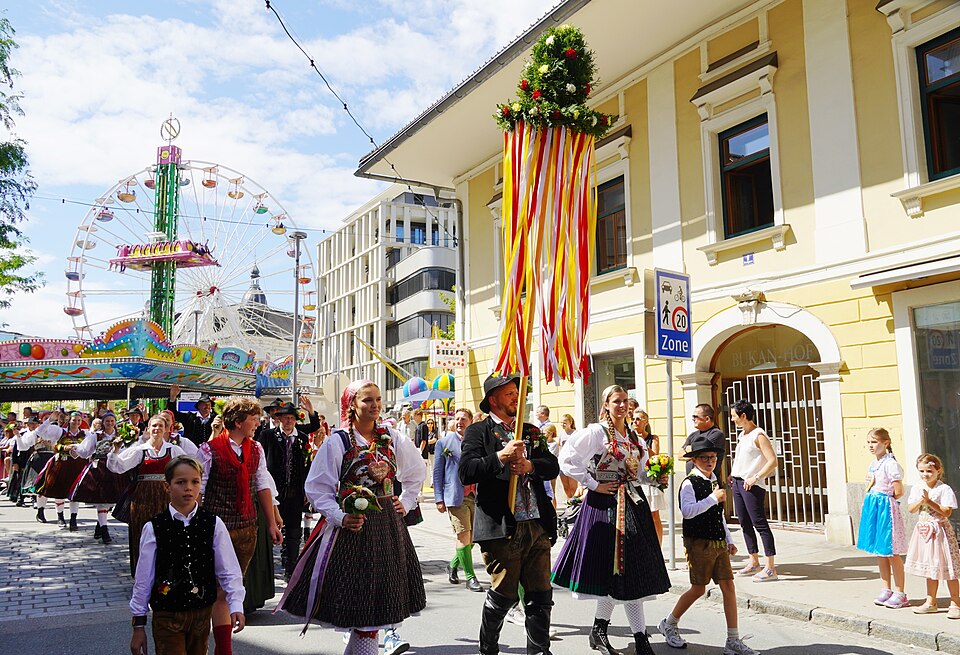
The local fair in Bleiburg, which derives its name from its actual location on an open field (“Wiese” being the German word for “lawn” or “field”), is one of the oldest time-honoured traditions in Austria’s South – and generally regarded as an event not to be missed, especially by the locals. Since its conception in 1393, the Wiesenmarkt is celebrated annually in early September, featuring highlights like the historic procession featuring the market regime and a distinct red pouch, the legendary clay ninepin alley, as well as culinary delights like doughnuts (“Krapfen”) served with traditional coffee in a mug. Another special feature is the so-called Krämermarkt: A four-kilometres-long row made up of over 300 stalls selling traditional and quaint treasures that have long since disappeared from the shelves everywhere else – whether hand-carved toys or traditional aprons.
| Did you know? German painter Werner Berg was a big fan of the Bleiburger Wiesenmarkt, capturing the festivities in many of his paintings. Today, his art is actually incorporated into the official traditional clothing collection of Bleiburg. |
The Day of the 1920 Carinthian plebiscite
On the 10th of October each year, the hustle and bustle in Carinthia is temporarily suspended: Schools and administrative offices remain closed, the capital Klagenfurt is host to various remembrance celebrations, and in many regions locals don their best traditional clothing while out and about. The reason? The 1920 plebiscite, where the Carinthian populace voted in favour of remaining Austrian instead of becoming part of Yugoslavia. A historic moment that has been observed accordingly year after year ever since.
Vierbergelauf (Four-Mountain Run)
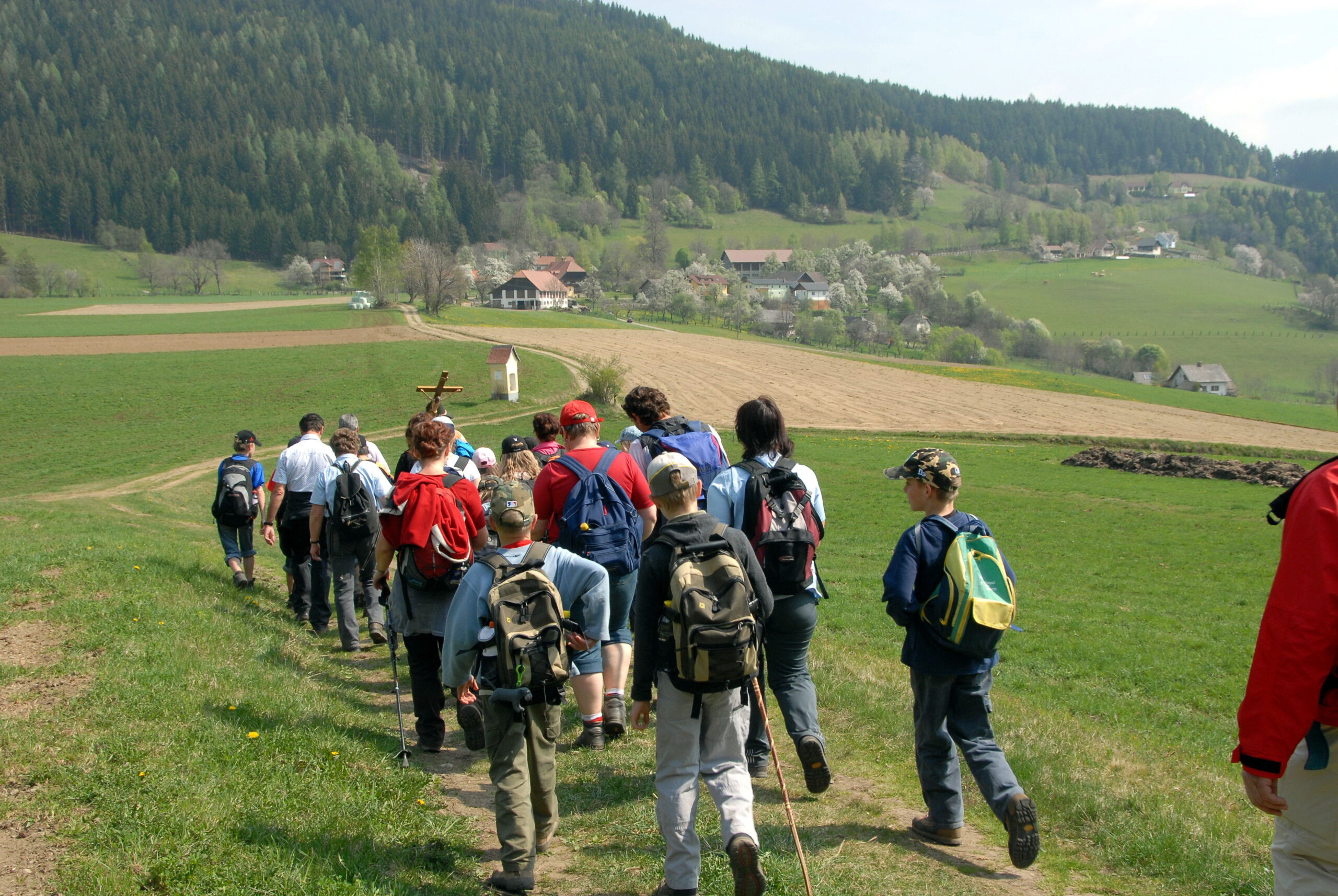
Every year on the second Friday after Easter, thousands embark on Carinthia’s oldest pilgrimage near the town of St. Veit an der Glan: a mountain run covering 52 kilometres and over 2,000 metres in altitude across the four holy peaks Magdalensberg, Ulrichsberg, Voitsberg and Lorinzenberg. The fun begins after midnight mass: Equipped with headlamps and sturdy shoes, participants make their way from one peak to another, singing, praying and gathering mountain leaves and plants along the way – folklore has it that ivy, boxwood and juniper protect against thunderstorms and lightning. Whenever the weary travellers reach a village, locals typically welcome them by setting off firecrackers and giving away sweets.
Kufenstechen
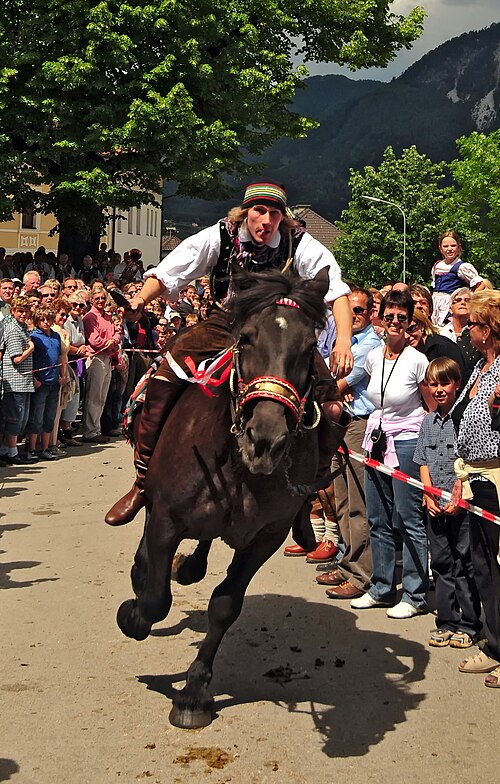
In the southwestern Gailtal region in Carinthia, horse riding is a firm part of the annual church parish festival. In an event called “Kufenstechen”, young men on heavy-set Noriker horses gallop through the village in an attempt to break a wooden crate using a one-kilogram heavy iron club. The tricky bit: no saddles allowed. Those who are successful qualify for the final round, where they are challenged to pick up a wreath. This is followed by traditional dancing, where couples assemble in colourful traditional costumes to dance under the village linden tree – the men still in their riding boots.
Where exactly this unique tradition came from, still remains a mystery. Common theories link it to medieval tournaments, others have tried to establish a connection to the Turkish sieges. One thing, however, is indisputable: That “Kufenstechen” is a centuries-old tradition that has been cherished and passed down from generation to generation. The most celebrated version of the event takes place annually on Whit Monday in Feistritz an der Gail, and is listed as an UNESCO intangible cultural heritage.
In addition to these famous festivities, there are many other, lesser-known traditions in Carinthia that are worth an honorary mention. One of them is the so-called diving for Christmas trees during Advent, where scuba diving clubs drop decorated Christmas trees into Carinthia’s many lakes to remember those who drowned. In the southeastern regions Lavanttal and Görtschitztal, “Roateln” is a common tradition: In the lead-up to Christmas, every blade in the house is whetted, and ceremoniously placed under the lavishly decorated table on Christmas Eve for good luck in the New Year. Plus, every July locals in Moosburg celebrate the so-called Kaiser Arnulfsfest in honour of the only emperor to ever hail from Carinthia.
Food and culture in Carinthia: From Reindling to choral singing
Whichever festivities in Carinthia you attend, traditional food and culinary delights are as much part of the celebrations as the event itself. At Easter, the “Reindling” is the star of the traditional Carinthian Easter feast: a sweet treat shaped like a Gugelhupf, made of yeast dough and cinnamon, sugar and raisins. Typically, you’ll also find a traditional dip made out of chopped hard-boiled eggs mixed with spicy horseradish and vinegar to go with the likes of Easter ham, sliced sausages and other savoury delights. On Christmas Eve, Southern Carinthians also serve up a true regional specialty: the so-called “green sausage”, boiled – not smoked! –and served with Sauerkraut and rye bread.
Another fun fact: Carinthia is also often referred to as the “land of singers”. And for good reason, at that. Chorals for several voices are a centuries-old tradition and still a feature of everyday modern life, whether in taverns or at local fairs. The Carolling in Heiligenblut, where children walk from house to house in the night from January 5 to January 6, is also part of the UNESCO intangible cultural heritage.
Whether horseback riding, church parish fairs or historical events: In Carinthia, custom and tradition are very much alive and celebrated in true style. While the exuberant festivities are always best enjoyed in person, there’s still plenty of reading material on our blog to get you in the mood before your next visit: whether our guide to Austrian cuisine, tips for what to do at a Heuriger and our lowdown on Austria’s most famous writers.