
When thinking about Austria and classical music, the Viennes Waltz and Mozart will most likely be the first things that come to mind. But Austria’s classical music scene has a lot more to offer. From the classical and Romantic periods all the way to the highly experimental sounds of the revolutionary Twelve-tone technique and Modernism: we’ll introduce you to some of Austria’s most famous composers, including music recommendations that perfectly capture what their style is all about.
Wolfgang Amadeus Mozart (1756–1791)
It’s safe to say that no other Austrian composer remotely compares to Wolfgang Amadeus Mozart when it comes to popularity and international renown. Whether oeuvres like A little Night Music, The Magic Flute, Don Giovanni or fan-favourite Rondo alla Turca, his works have significantly shaped classical music – and continue to be enjoyed to this day by millions all over the world. Not just because of their lightness and the rich abundance of melodies, but also because of the inherent emotionality that is evident in many pieces, particularly his later ones. Remarkably, the whizkid from Salzburg began composing his first pieces aged just five, and was soon after travelling all over Europe with his father Leopold. After moving to Vienna in 1781, Mozart worked as a freelance composer, writing over 600 pieces including everything from operas and concertos to symphonies, piano sonatas and chamber music.
Listen to: Piano Concerto in A-major
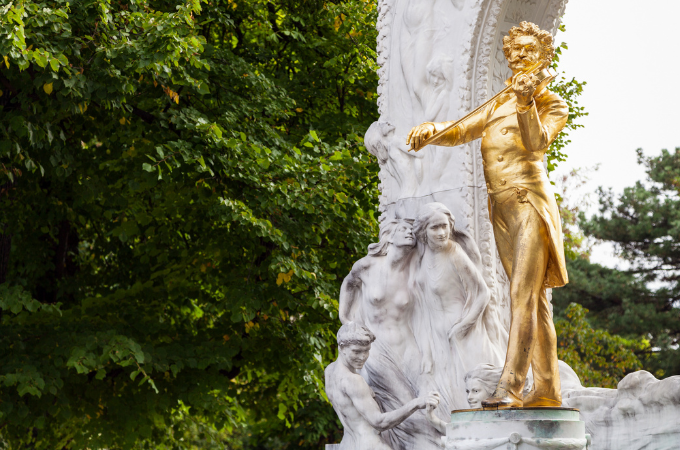
Johann Strauss II. (1825–1899)
Dubbed the “King of the Waltz”, Johann Strauss Sohn was instrumental in making the Viennese Waltz a global phenomenon, while other famous works like his operetta Die Fledermaus to this day remain firm favourites of the international concert repertoire. Which may not be all too surprising, given that no other composer has managed to capture the joie de vivre, elegance and passion for dancing synonymous with 19th century culture in such impressive fashion. No New Year’s Eve Celebration in Austria would be complete without dancing to the Blue Danube Waltz at midnight – a tradition that dates back generations. As such, it is also featured in the world-famous New Year’s Concert together with the Radetzkymarsch written by his father Johann Strauss I.
Listen to: Ouverture from DieFledermaus
Anton Bruckner (1824–1896)
From humble beginnings to international fame: Although his pieces didn’t particularly impress the critics of his time, Bruckner is now considered one of the most important Romantic symphonic composers. Influenced by his deeply religious surroundings (his father was a vicar), he focused on church music early on in his career, and was also engaged as an organist at Linz and St. Florian in Upper Austria. While his masses and his oratory Te Deum are perhaps his most celebrated compositions, his oeuvre is mostly defined by his monumental symphonies which marry a strong severity and deep spirituality with tonal power, already showing clear signs of Modernist influences.
Listen to: Symphony No. 4 in E-flat Major (“Romantic”), conducted by Claudio Abbado
Joseph Haydn (1732–1809)
Born in 1732 in the village of Rohrau in Lower Austria, the „Father of the Symphony” is generally considered the true pioneer of the First Viennese School. For over 30 years, Haydn was in the employ of the court of Esterhàzy, composing hundreds of works during his tenure – all of which are easily distinguishable by their humorous note and an abundance of creativity, while remaining captivatingly simple. He also defined the form of the classic concertante quartet. Throughout the 1790s he regularly traveled to London, which helped bolster his international renown. His most notable works are the London Symphonies, as well as his oratories The Creation and The Seasons.
Listen to: The Creation
Franz Schubert (1797–1828)
Whether Erlking or Die Forelle: With over 600 lieder, Franz Schubert is generally regarded the uncontested master of song art. At the tender age of 17, he wrote his famous piece Gretchen at the spinning-wheel, and went on to add thousands of compositions to his oeuvre – despite his early death. His output included a wide variety of compositions, from songs and symphonies to piano works and chamber music. Synonymous with the Romantic period of musical history, Schubert’s works are characterised by a unique lyricism and intimate melodies, often tinged with a deep sense of melancholy. While his Unfinished Symphony and lieder cycles like A Winter Journey are generally considered masterpieces of classical music, his many Impromptus are well loved around the world, and embody Schubert’s romantic-melancholic style particularly well.
Listen to: Impromptu No. 4 in Ges-Dur (Vladimir Horowitz, Wiener Musikverein 1987)
Gustav Mahler (1860–1911)
Born in Kalischt, Bohemia (today: Kaliště, Czechia) in 1860, Gustav Mahler ranges without doubt amongst the musical greats: His works were instrumental in paving the way for the traditional Austro-German style to enter the Modernist era, featuring monumental sounds coupled with a soft emotionality. Ranging from light and approachable to wild, chaotic and at times oppressive, his symphonies still manage to capture audiences all over the world – with Symphonies No. 2 (“Resurrection”) and No. 6 (“Tragic”) featuring amongst the most famous. In addition to being a prolific composer, Mahler was also one of the most celebrated conductors of his generation, and also served as the director of the Court Opera House in Vienna between 1897 and 1907. He spent his last years in the US, being appointed both by the Metropolitan Opera and the New York Philharmonic.
Listen to: Symphony No. 1 (“Titan”) conducted by Pierre Boulez
Arnold Schönberg (1874–1951)
Heralded as a musical revolutionary, Schönberg is considered one of the most influential composers of the 20th century. As the founding father of the Second Viennese School, he decided to forego tried-and-trusted patterns and developed his so-called Twelve-tone technique, which went against all the established conventions – and would eventually shape the works of generations of future composers. Schönberg was also working as music theorist and teacher, with Alban Berg and Anton Webern amongst his most famous students. With drastic political changes in Vienna looming, he eventually migrated to California in 1933 and took American citizenship in 1941. Some of his most famous works include Transfigured Night and his opera Moses and Anon, both of which emphatically capture the transformation from Late Romanticism to Atonality and Modernism.
Listen to: Chamber Symphony No. 2
Alban Berg (1885–1935)
As a student of Schönberg, Alban Berg’s works similarly follow the strict rules of the Twelve-tone technique, although a touch of late Romanticism is clearly noticeable. The premiere of his opera Wozzeck in Berlin in 1925 catapulted him to fame, with his second opera Lulu – although unfinished – generally considered one of the most significant compositions of the Modernist era. The recipe for success? Emotional depth, a high degree of lyricism as well as capturing the dramas of human behaviour and life as a whole – all of which were key in ensuring that Berg’s music remained approachable for the masses despite the obvious modern influences and his break with musical traditions.
Listen to: 3 Orchesterstücke, op. 6
Anton Webern (1883–1945)
Like his contemporary Alban Berg, Webern was also studying under Schönberg and part of the Second Viennese School. His works are generally characterised by their extreme complexity and depth, despite being usually short, succinct and minimalistic in character, as well as defined by a distinct, pointillistic musical language. Although his oeuvre of roughly 30 opus-numbered compositions is comparatively small, he significantly influenced the post-war avant-garde. Webern was also active as choirmaster and conductor, with Mahler’s works being a firm favourite of his repertoire.
Listen to: Five pieces for Orchestra, op. 10
Want to know more about Austrian music, culture and cuisine? Then you’ll find plenty of reading material on our blog: from our in-depth guide to Austrian culinary delights and fascinating facts about Viennese coffee specialties to everything you need to know about Austrian customs and traditional clothing. Plus, we’ve also got practical tips for your next visit at a Heurigen. Happy reading!