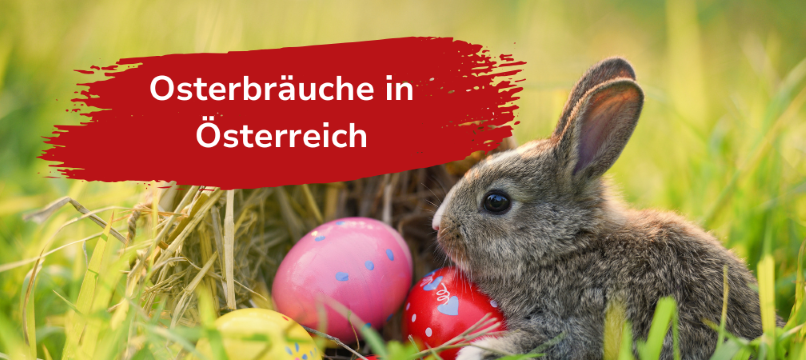
From egg hunts for the little ones to the festive Easter feast and a wealth of regional customs found in every corner of the country – Austria boasts truly unique traditions that exist nowhere else in the world. Here’s an overview of the most important ones, including regional highlights from East to West.
Blessing of the palms
Before the Easter Bunny starts making its rounds, Palm Sunday is celebrated in many Austrian communities with the Palmweihe (“blessing of the palms”), a traditional church blessing. Elaborately crafted bouquets made from willow catkins, boxwood, thuja and hazel twigs, often with a decorated egg nestled right in the centre, are carried to church to be blessed. Putting one together, by the way, is by no means an adults-only affair. In schools and kindergartens across the country, it’s a firm fixture of the pre-Easter season.
‘Ratschen’
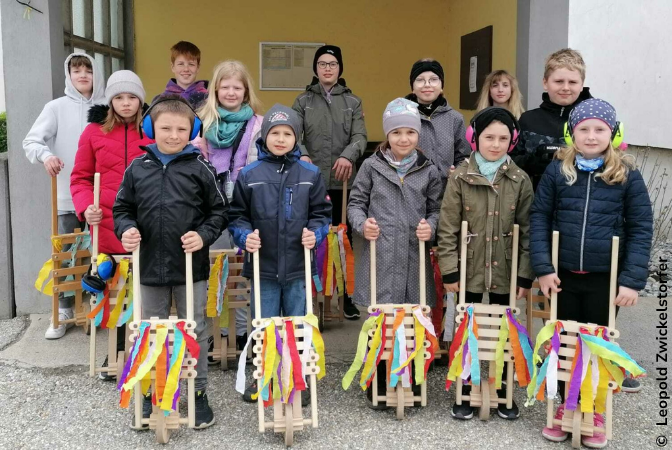
From Maundy Thursday onwards, many Austrian church bells fall silent. Legend has it they fly off to Rome and don’t return until Easter Sunday. The silence they leave behind is filled throughout Holy Week by one of Austria’s best-known Easter customs: “Ratschen”, where Groups of children equipped with wooden ratchets roam through the villages, making a loud rattling noise and reciting rhymes along the way.
The Easter bouquet
Maundy Thursday is also traditionally the day to cut the branches for the traditional Easter bouquet, the so-called Osterstrauch. Made-up of willow catkins, birch or hazel twigs, it’s kept indoors as a decorative feature until Easter Sunday – ideally bursting into bloom until the big day to symbolise the awakening of spring. Most are also decorated with colourful, hollowed-out eggs and ribbons.
Blessing of the Easter Basket
On Holy Saturday, many communities gather for the traditional blessing of the Easter food. Those who wish to take part bring their Easter basket to church – typically filled with ham, eggs, horseradish and bread – to be blessed by the priest. The custom is particularly popular in Styria, where it’s affectionately known as the “eighth Styrian sacrament“: mainly because it tends to draw out churchgoers who are rarely seen in the pews throughout the year.
Easter Bonfire
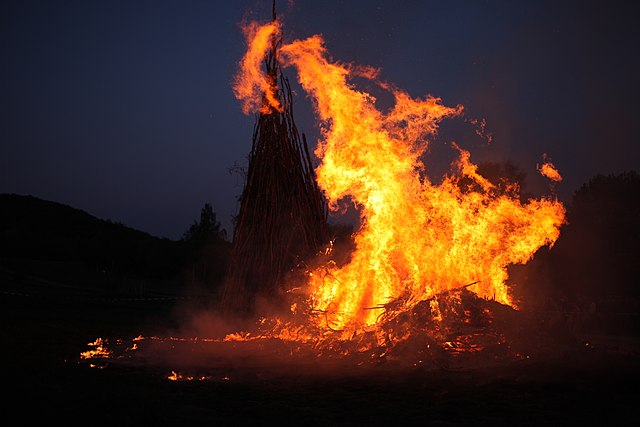
Holy Week draws to a close with the Easter bonfire, which lights up the skies on the night between Holy Saturday and Easter Sunday. Originally intended as a ritual to welcome the warmer season and banish winter for good, the tradition took on a new meaning with the advent of Christianity, becoming a shining symbol of the resurrection of Jesus. Especially in Austria’s alpine West this tradition is a spectacle of its own kind: Wood is gathered for weeks in advance and stacked into elaborately crafted towers with a height of up to ten metres – before it all goes up in flames on Easter night.
Easter Egg Hunt
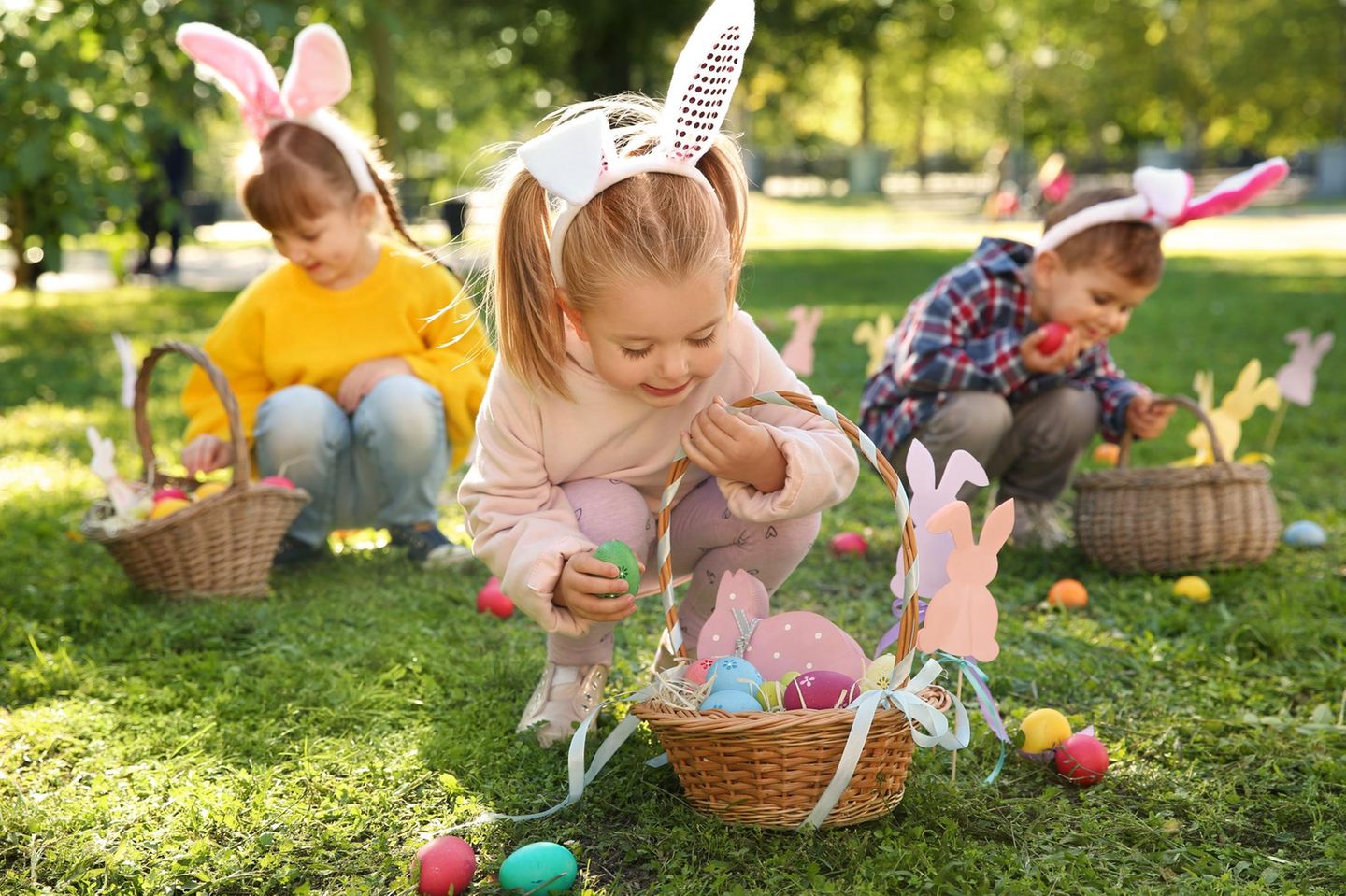
Easter Sunday brings what is arguably the most eagerly awaited moment of the entire season – and especially for the little ones. At some point in the morning, the Easter Bunny has come and gone, hiding small nests (often small baskets, cardboard boxes or pouches) filled with Easter eggs, chocolate and other little treats at home. Fun fact: It wasn’t actually until the late 17th century that the Easter Bunny became the designated person for the job – previously, the stork, fox or cuckoo had been equally popular characters.
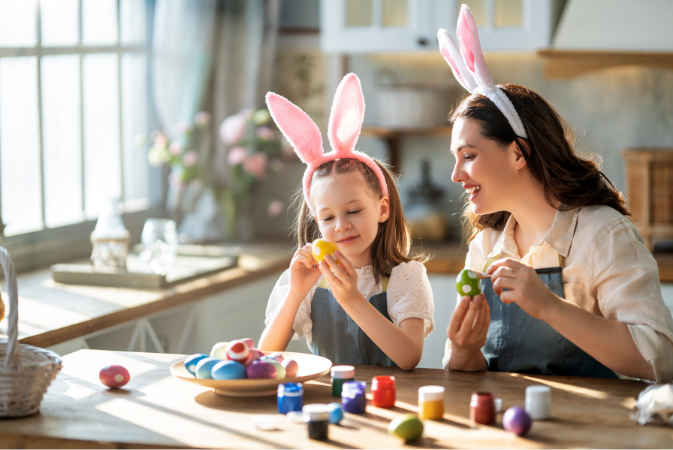
Why eggs, you may wonder? The reason is as charming as it is practical: During Lent, eggs weren’t on the menu, but the hens obviously didn’t stop laying them. So in order to preserve and store them over a longer period of time, the eggs were hard-boiled. Obviously there had to be a quick way to tell them apart from raw ones, which is why they were dyed using onion skins, spinach or beetroot. While not a necessity anymore, the custom of colouring eggs is still a firm fixture of the Easter season – as much as the Easter egg hunt itself.
Egg tapping & Easter egg roll
Once the eggs are found, the real fun begins. During egg tapping, a traditional Easter game played in pairs, each player holds a hard-boiled egg in their hand and taps it against an opponent’s, trying to crack theirs without breaking their own. Those who prefer a gentler approach can try egg rolling, a popular custom in Carinthia where eggs are sent down a small slope. The one that rolls the furthest wins, while anyone whose egg gets hit by another has to pay a small fine. This is where the bright colours really come in handy – after all, everyone needs to know which egg is theirs!
The Easter Feast
The big event of Austrian Easter tradition is undoubtedly the traditional Easter feast: A mouthwatering assortment of the country’s remarkable culinary variety, with hard-boiled eggs, Easter ham and freshly grated horseradish being the main stars on tables across the country.
In Carinthia, the cured meats are usually served with Reindling – a rich, sweet yeasted cake with cinnamon, sugar and raisins. Styria has a similar treat called Osterpinze, which is slightly sweet with a delicate hint of anise. Further north, Vienna’s Easter ham is traditionally baked encased in bread dough until gloriously crispy, while Upper Austria brings “Oafleck” to the table – a dense egg bread served alongside the Easter meats. The Tyrolean equivalent is “Fochaz”, an oven bread scored with decorative patterns and served with egg salad and rolled ham. And in Vorarlberg, things get even more rustic with Nüssleschinken (a type of nutty ham), sauerkraut and dark rye bread.
For dessert, many regions serve the so-called “Osterlamm” (literally: Easter lamb): a sponge or pound cake baked in the shape of a lamb, often served with a glass of homemade eggnog.
Easter Traditions Across the Regions
Food isn’t the only thing that varies from region to region. Alongside the customs shared across the country, each of Austria’s nine states boasts a number of unique and distinct Easter traditions.
Lower Austria
In the Weinviertel wine region, Easter Monday is a celebration of nature coming back to life – and a good excuse for a leisurely walk coupled with a hearty picnic. The so-called Emmaustag is a call to head out into the vineyards, where winemakers and guests enjoy a leisurely stroll in the spring weather, accompanied by wine, bread and smoked meats – a tradition that can be officially found on the list of UNESCO’s Intangible Cultural Heritage.
Carinthia
On Good Friday, farmers in the Gurk and Metnitz valleys still honour an old, almost forgotten custom: a shot of schnapps raised to a sharp scythe and a bountiful harvest.
Holy Saturday then brings not one but two fiery traditions. In the Schwammweihe, homes are smoked out with blessed embers to ward off evil. And in some communities, torchbearers carry flaming spruce trunks weighing up to 40 kilograms across the fields – a ritual blessing of the soil and protection against storms.
Upper Austria
In Upper Austria, particularly in the Salzkammergut region, one long-standing Easter custom is still going strong: Oarradeln. On the night between Easter Sunday and Easter Monday, anything with wheels left outside – whether bicycles, wheelbarrows or trailers – disappears, only to turn up the next morning in the most unlikely of places.
Burgenland
Burgenland boasts two very unique Easter customs that couldn’t be more different. In the south of the region, traditional egg scratching is still going strong after hundreds of years: Hard-boiled eggs are first dyed a deep brown colour using onion skins, then subsequently etched with delicate patterns using a knife or fine blade.
Those who prefer action and noise don’t have to search far and wide either: On Holy Saturday, some communities in southern Burgenland celebrate the season by blasting milk cans into the air with a deafening bang. Originally intended to drive away evil spirits, it’s now mainly about the spectacle rather than anything else.
Styria
Two very unique customs can also be found in Styria: On Holy Saturday, children take on the role of fire bearers, carrying torches lit at the blessed church fire from house to house to smoke out each room for protection and blessing.
In the villages of Hitzendorf and Mooskirchen, the celebrations on Easter Sunday turn ceremonially loud. Maschtasingen, a singing tradition dating back to the 14th century, is a living reminder of a promise made by the men who survived the plague: to sing every year for as long as they lived. With very few exceptions, that promise has been kept ever since by the community while making its way towards Easter mass.
Salzburg
In the Großarl Valley in Salzburg, a wholly unique tradition has been observed every Maundy Thursday and Good Friday since the Middle Ages: Ölbergsingen (literally: Mount Olivet singing). Two choirs of around thirty men each sing through the entire night – the farmers on Maundy Thursday, everyone else on Good Friday.
The lighthearted counterpoint is the so-called Goneslauf in Wölting near Tamsweg, marking the official end of the Easter celebrations on Easter Monday. Several couples line up in a long row, with one person – the eponymous Gones – standing at the front of the line by himself. When the call to scatter goes out, the couple last in line are required to split up and run, while the Gones tries to claim the girl for himself. If successful, the role is passed on to his rival – and the game starts all over again.
Tyrol
In Tyrol, the Easter season kicks off with a touch of humour: whoever sleeps in longest on Palm Sunday gets affectionately nicknamed the “palm donkey“. However, the high point of the celebrations is the traditional procession that follows. While girls carry a Palmbuschen (bouquets made from pussy willow), the boys haul so-called Palmlatten around – long poles made from olive branches and willow catkins, decorated with colourful ribbons and sweet pretzels. In Imst, this turns into a full-blown competition for the longest pole, with the longest reaching lengths up to 35 metres.
Vorarlberg
In the Bregenzerwald region, the night before Easter Sunday is marked by a custom found in only a handful of communities: “Hanging up the rooster“, or “Gigalar ufhänga” in the Austrian dialect. Young men hang a rooster in a cage outside the home of a girl they admire and scatter a trail of sawdust leading to her front door. The more generous the scattering of sawdust, the greater their admiration.
Vienna
Vienna does Easter a little differently. As a large city without strong agricultural roots or tight-knit village communities where many of these customs were born, the capital takes a slightly less traditional approach in the form of Easter markets. In front of Schönbrunn Palace, on the Freyung and Am Hof, the city’s squares are transformed into atmospheric meeting places filled with handcrafted goods, regional specialities and Easter decorations.
By the way: There’s plenty more facets to discover about Austria on our blog – from Austria’s most famous composers and writers to regional traditional clothing and everything you need to know about a visit to a Heurigen. And if you’d like to better understand the German language, the Österreich Institut offers German courses for every level for individuals, groups and companies. Happy reading!