Austrian TV series have little interest in glossy, picture-perfect worlds. Instead, they are firmly rooted in real life: from council estates and government offices to sleepy provincial backwaters and Vienna’s poshest districts. Many productions put working-class families or idle civil servants centre stage, pushing their everyday conflicts, petty grievances and power plays to grotesque extremes.
Where many US formats first and foremost rely on tense, fast-paced and action-packed scenes, Austrian TV shows are all about strong dialects, edgy characters, colourful language and deliberately “imperfect” German. Dark humour, sharp social observations and satirical commentary are the basis for stories that will keep you laughing while making you feel ever so slightly uncomfortable. Just take a look at the best Austrian productions!
The Best Austrian Comedy Series
Whether it’s a council estate, an upmarket neighbourhood, a sleepy provincial town or a government office— Austrian TV comedy leaves no social setting untouched. The common theme? Corruption, double standards and human weakness crop up time and again, whether in a working-class backstreet or a corner office.
Ein echter Wiener geht nicht unter (1975-1979)
Things get decidedly rough in ‘Ein echter Wiener geht nicht unter’ (loosely translated as ‘A real Viennese man never goes down‘). Set in the working-class district of Favoriten, the series revolves around Edmund “Mundl” Sackbauer (Karl Merkatz), a cantankerous family patriarch. He is famous for his colourful insults and barely veiled threats—the kind that leave little doubt about his temperament. When neighbourly disputes break out, his preferred method of conflict resolution is a full-volume shouting match. The series caused quite a scandal at the time of its release. The blunt working-class dialect and unvarnished portrayal of lower-class life were unlike anything shown before on Austrian TV.
Kaisermühlen Blues (1992-1997)
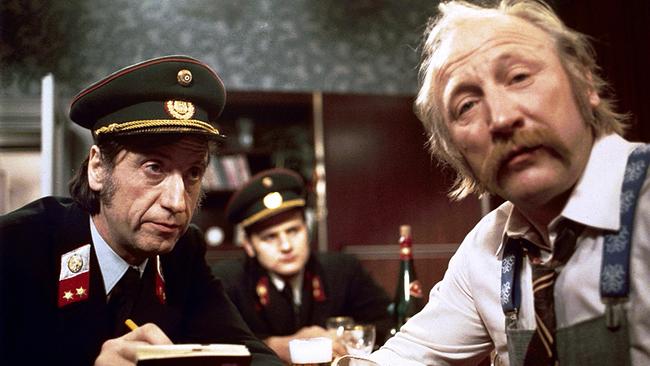
Kaisermühlen Blues takes a close, unsentimental look at everyday life in the Viennese council estate Schüttauhof. Here working-class routines, racism, alcoholism and neighbourly drama are played out with a satirical edge. The colourful ensemble features the warm-hearted tobacconist Gitti Schimeck (Marianne Mendt), the down-to-earth Inspector Trautmann (Wolfgang Böck), and the wily Mr. Täubler (Roland Düringer), a legend of the Austrian comedy scene. It also includes the perpetually gossiping Mrs. Kaiser (Ellen Umlauf) and her dog Wasti. The cast is rounded out by the no-nonsense caretakers Turecek (Brigitte Neumeister) and Koziber (Brigitte Swoboda), as well as the endlessly scheming and reliably corrupt local politicians Kneisser (Social Democratic Party, Otto Grünmandl) and Schoitl (Austrian People’s Party, Heinz Tichatsch).
Vorstadtweiber (2015-2022)
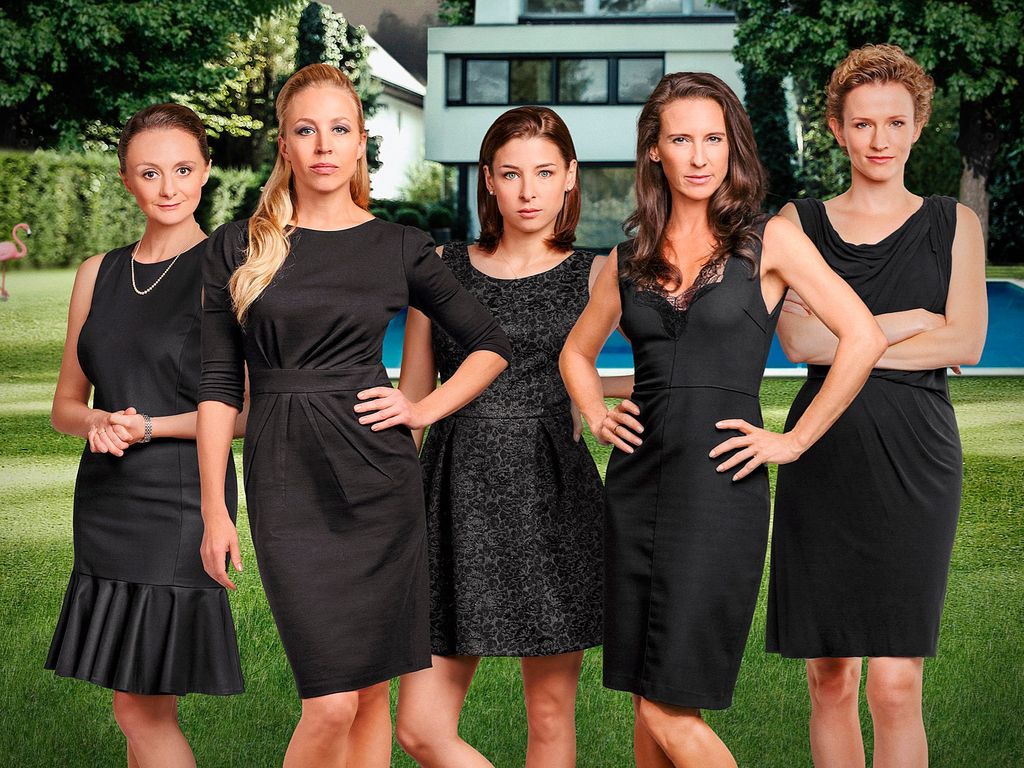
Vorstadtweiber couldn’t be more of a contrast. Set in Vienna’s more affluent districts, the series—often described as Austria’s answer to Desperate Housewives—centres on status-obsessed, scheming women and career-driven, morally ambiguous men of the Viennese upper class. Behind the designer lifestyle, lavish parties, status symbols, and social performance lies a web of greed, power, sex, and money that holds everything together. Until relationships crack and scandals begin to surface.
Linguistically, the series is a study in contrasts. It combines polished Austrian German with bursts of Viennese dialect, delivered with the full arrogance of its characters.
Braunschlag (2012)
In David Schalko’s Braunschlag, greed, political corruption and Catholic double standards are set against the scene of a small Lower Austrian village. When mayor Gerhard Tschach (Robert Palfrader) stages a Marian apparition to save the council from financial ruin, things quickly spiral out of control. A pitch-black satire of the darker parts of provincial life in Austria.
Altes Geld (2015)
Also from David Schalko, Altes Geld (‘Old Money’) is a biting portrait of a wealthy Viennese industrial dynasty. When the terminally ill patriarch Jakob Sarator (Karl Markovics) tells his children that whoever finds him a donor liver will inherit the family fortune, the race is on. The battle for power and the moral high ground reveals Austria’s cynic side, where corruption, double standards and cold-blooded family dynamics are rife in gilded social circles.
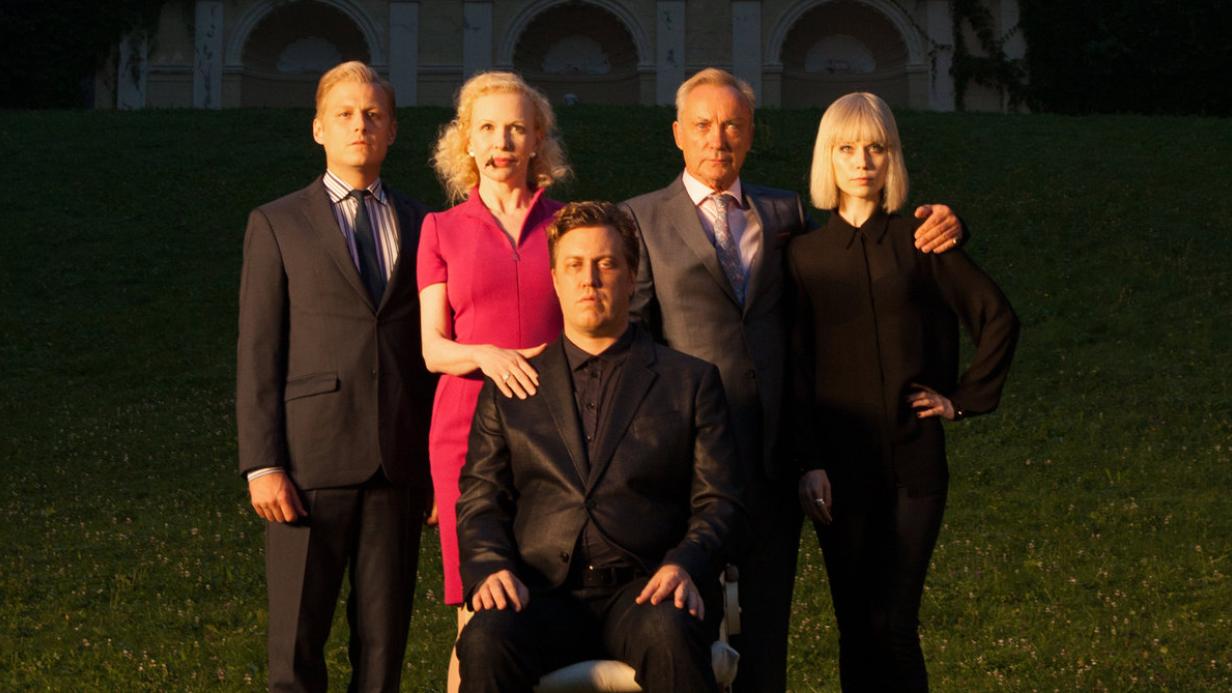
Bösterreich (2016-2018)
Created by Hosea Ratschiller and Peter Turrini, Bösterreich—a play on “böse” (evil) and “Österreich” (Austria) – blends political satire with absurdist Austrian humour. The series tackles contemporary issues like bureaucracy, xenophobia, media culture in short episodes, in which each topic is often pushed to grotesque extremes, regularly featuring Nicholas Ofczarek or Robert Palfrader in wildly versatile roles. The result is a mirror held up to society’s neuroses, in which evil appears not as an exception, but a completely normal feature of Austrian life.
MA 24/12 (1998-2002)
MA 24/12—the ‘MA’ stands for ‘Magistratsamt’, Vienna’s municipal authority—parodies a fictional city department dedicated entirely to Christmas decorations, taking bureaucratic absurdity to gleeful extremes. At the centre are pompous Ing. Breitfuß (Roland Düringer) and crude Herr Weber (Alfred Dorfer), who spend their working hours harassing applicants, pocketing bribes, and killing time building model cars or leafing through car magazines and Playboy. Blonde secretary Frau Knackal (Monica Weinzettl) is permanently engaged in personal phone calls, as well as an affair with her superior, a member of the Senate staff (Wolfgang Böck)—who only set up the department in the first place to cover up the affair. Together, the characters embody a set of thoroughly Austrian clichés: institutional unhelpfulness, red tape and casual sexism.
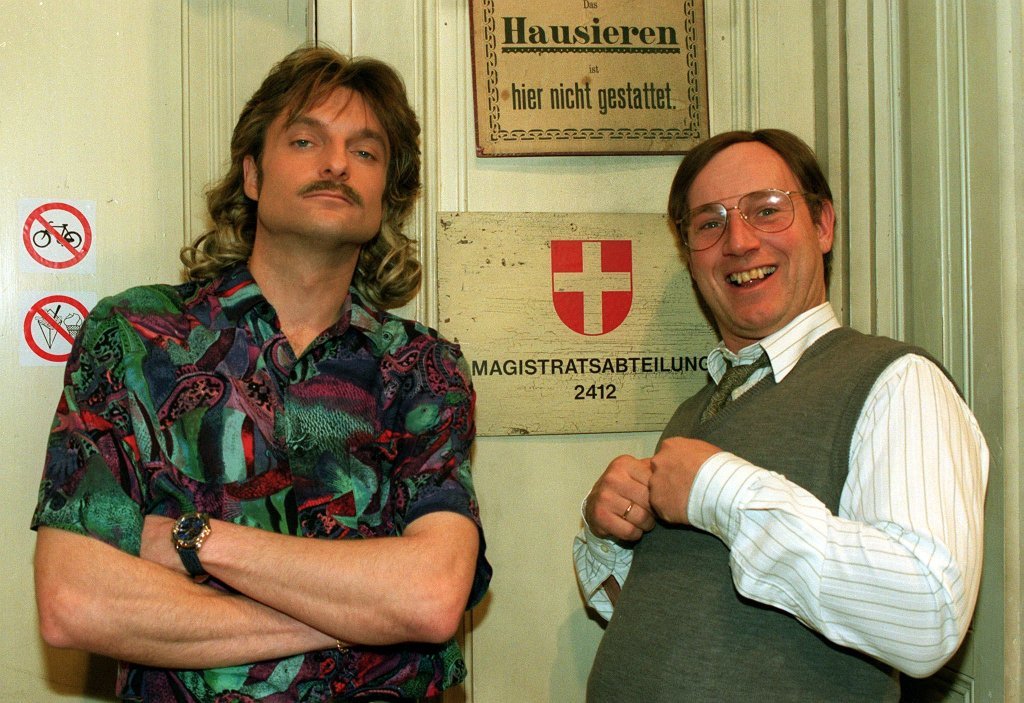
Weber & Breitfuß (2022–)
The spin-off Weber & Breitfuß reunites the two cult figures from MA 24/12 in new surroundings. Roland Düringer and Alfred Dorfer are reprising their roles—this time navigating rehabilitation clinics and political settings. The formula remains the same: bureaucratic absurdity and Austrian self-satisfaction, but with a refreshing twist.
Austrian Crime Series
Beyond satire and dark humour, Austria has a long tradition of action-driven crime series. Whether it’s the murky underworld of Vienna or a deceptively quiet, rural idyll, the productions below prove that despite the scenic backdrop of the Austrian Alps and romantic rivers, crime is just around the corner.
Trautmann (2000-2010)
The Viennese crime series follows District Inspector Richard Trautmann (Wolfgang Böck), who—after separating from his partner—finds himself transferred to the city’s 2nd district, Leopoldstadt, where he investigates murders in the city’s underworld alongside Burschi Dolezal (Simon Schwarz) and Monika Tränkler (Monica Weinzettl). The series shines a light on Vienna’s grittier side featuring gang warfare, prostitution and corruption—all served with a dry sense of humour.
Kommissar Rex (1994-2004, Austrian episodes)
The cult series follows a succession of Viennese detectives—including Richard Moser (Toby Walker), Max Koch (Gabriel Barylli) and Marc Hoffmann (Gedeon Burkhard)—and their loyal police dog Rex, who proves indispensable in solving murders, extortion cases and gang crimes. Equally appealing to younger audiences, the series balances tension with humour across a range of urban Viennese settings, from popular nightclubs to the city’s docks.
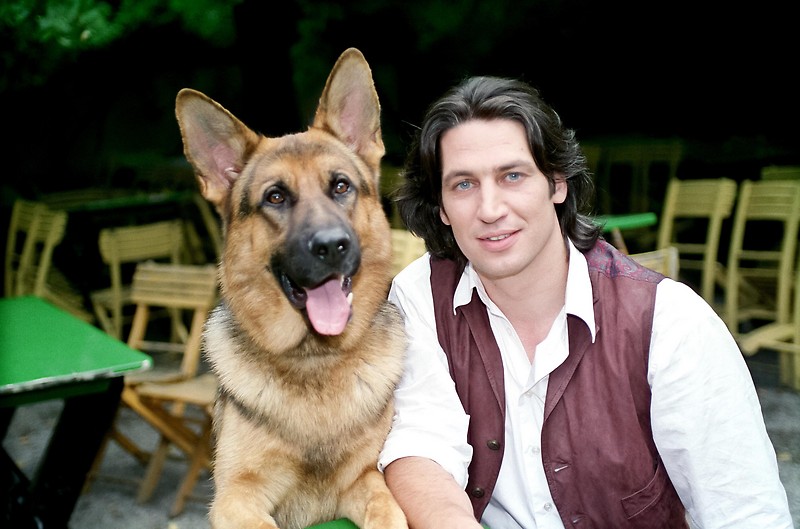
Stockinger (1996-1998)
In this Kommissar Rex spin-off, police officer Ernst Stockinger (Nikolaus Waldschmidt) follows his wife Karin (Franziska Weisz) to the Salzkammergut—an Austrian region near Salzburg—where she takes over her father’s dental practice. Far from a quiet life, he soon finds himself investigating mafia killings and xenophobic crimes—cases that sit in sharp contrast to the picture-postcard surroundings.
Soko Donau (2005–)
Soko Donau follows a Viennese special operations unit—SOKO being short for ‘Sonderkommission’, Austria’s equivalent of a task force—investigating crimes along the Danube. Now in its twentieth season, the series has built up a loyal following over the years, with a rotating cast of characters keeping things fresh. The current core team is led by Oberst Henriette Wolf (Brigitte Kren), with long-serving Inspector Penny Lanz (Lilian Klebow) as one of the few constants throughout the show’s run. Corruption, identity fraud and cross-border crime are recurring themes.
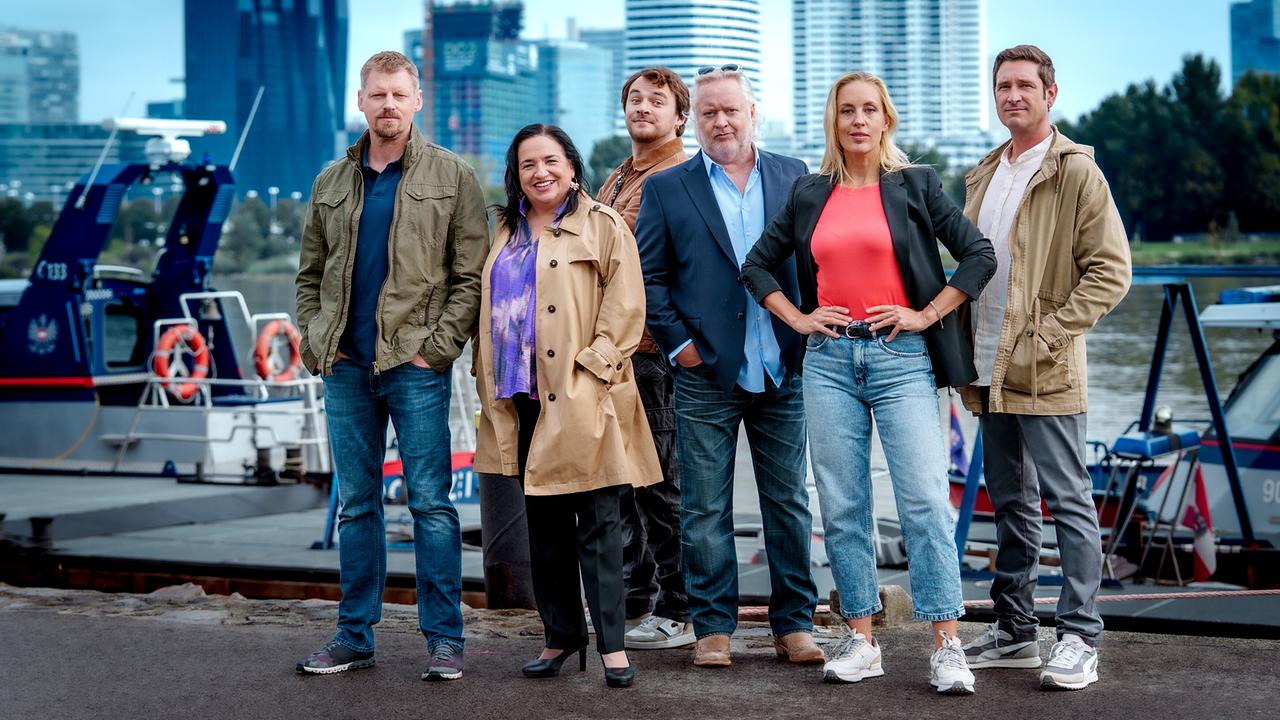
Soko Kitzbühel (2003–)
Set against the glamorous backdrop of the world-famous Tyrolean ski resort, Inspector Janni Harnisch (Daniela Zigli), psychologist Lukas Roither (Robert Ritter) and their team investigate murders in the world of the rich and beautiful. The cases themselves blend psychological depth with elements of local folklore and legend.
‘Der Pass’ (2018-2022)
In this thriller, Austrian detective Ellie Stocker (Julia Jentsch) and her German counterpart find themselves investigating a series of gruesome murders along the border. Beneath the crime storyline unfolds a psychological drama about guilt, power and local myths. The contrast between Alpine idyll and violence paints a picture of a world balanced on the edge between order and chaos.
Whether lighthearted comedy or dark crime thriller, all of these series have one thing in common: showing just how far self-deprecation and precise social observations can go, with the characters introduced to us – the grumpy working-class dad, the idle civil servant, the corrupt small-town politician – mirroring our own fallacy and quirky everyday habits.
Plus, there’s plenty more to discover on our blog: explore the world of Austrian authors whose works have inspired more than one screenplay, or set off on a culinary journey through Austrian cuisine – ideally with a stop at a traditional Heurigen. And if you’d like to find out how Austria celebrates away from the screen, take a look at our articles on customs and traditions or the Viennese ball season. Happy reading!